PRESS RELEASE
TOPOLOGIES OF THE UNSEEN by Predrag Popara
Curated by WHY NAT
The exhibition Topologies of the Unseen by Predrag Popara opens on Thursday, April 2, at 7 PM, at Krunska 73, Belgrade. The exhibition is organized in collaboration between WHY NAT Projects and the CMS Collection.
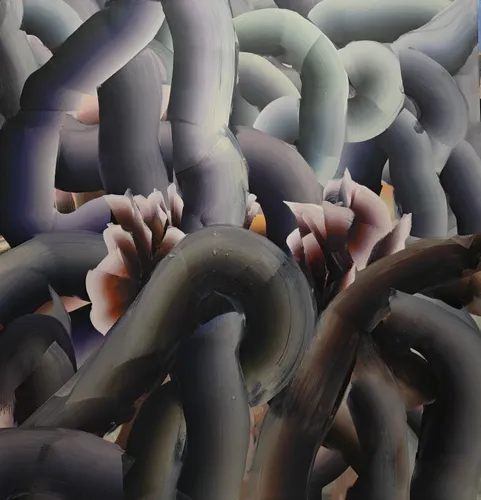
The show will feature around ten works from Popara’s latest series (2022–2026), with a focus on monumental formats. These works continue the artist’s exploration of complex relationships between abstraction, materiality, and elemental forces. Popara’s paintings do not function as representations but as events—a space where energy accumulates, transforms, and establishes a dialogue with the viewer.
His works do not depict landscapes in a traditional sense; rather, they construct fluid, imaginary systems in which water, air, earth, and fire intersect, generating intricate relationships between movement and stability, chaos and order. Through layered textures, emphatic gestures, and intense chromatic contrasts, Popara articulates liminal states—zones between emergence and disappearance, formation and dissolution. Each surface carries traces of the performative act, recording the process of creation and creating a dynamic, multi-layered visual experience.
Central to Popara’s practice is the relationship between humans and nature. In his work, nature is neither illustrative nor nostalgic; it is an immanent framework of existence—a continuum where the subjective and material, the internal and external, intertwine. The series Nature as Universal Energy Form reflects contemporary instability—ecological, social, psychological, and existential—while monumental formats amplify both the physical and emotional impact. The viewer becomes an active participant, engaging with the process, perception, and contemplation that Popara’s paintings encourage, reconnecting with elemental forces that shape both nature and human experience.
Through his work, Popara redefines painting as a living, processual system—not merely a reflection of the world, but an extension of it. Color, gesture, and material in his compositions create a dialogue between the visible and invisible, chaos and order, transient and enduring, while evoking both introspective and universal dimensions.
Topologies of the Unseen
Predrag Popara’s painterly practice emerges as a dynamic and relational field between abstraction, materiality, and elemental forces, where the image does not function as representation but as an event—a space in which energy accumulates, transforms, and resists fixed meaning. His works do not depict landscapes in the traditional sense; rather, they constitute them as fluid, imaginary systems in which water, air, earth, and fire intersect, generating complex relations between movement and stability, chaos and order. In this sense, the painting becomes a site of continuous transformation, a process that unfolds both before the viewer and within perception itself.
Through layered textures, intense chromatic contrasts, and emphatic gesture, Popara articulates liminal states—zones between emergence and disappearance, form and its dissolution. His compositions develop as open systems, in which matter, color, and gesture remain in constant interaction. The pictorial surface operates as a record of process: a trace of time, movement, and the internal dynamics of the image, where each layer builds upon the previous one, forming a complex structure of visual and tactile relations. Color here is not descriptive but operative—it generates optical tensions and spatial ambiguities, evoking organic, geological, and atmospheric processes without closing down meaning.
The relationship to nature in this body of work is neither illustrative nor nostalgic, but ontological and existential. Nature appears as an immanent condition of being—a continuum that connects the subjective and the material, the internal and the external. In this context, Popara’s practice can also be read as a response to contemporary conditions shaped by acceleration, fragmentation, and a loss of direct connection to the elemental structures of reality. His paintings do not offer narrative; instead, they create conditions for experience: they slow perception and open a space for contemplation, for reattuning to what is enduring yet often suppressed.
In the series Nature as Universal Energy Form (2022–2026), part of which is presented in this exhibition, this approach gains further articulation. The works reflect multiple forms of contemporary instability—ecological, social, existential, and psychological—through a pictorial field in constant transformation. Forms emerge and dissolve, break apart and reconfigure, while the surface retains traces of the performative act. In this sense, painting here approaches the temporal arts: it registers flow, change, and the tension between control and unpredictability, between intention and contingency.
An important aspect of Popara’s work is its openness toward the viewer. The visual language he develops remains incomplete without perceptual and imaginative engagement. Meaning does not reside within the image as a closed system, but emerges in the encounter—in a space of projection, memory, and affect. In this way, his compositions function as perceptual and affective catalysts, activating individual experience while simultaneously connecting it to more universal structures.
Popara’s practice ultimately redefines painting as a living, processual system—not as a reflection of the world, but as its extension. His works can be understood as condensations of material, affective, and elemental flows, where the natural and the human, the visible and the invisible, intersect. In encountering these works, the viewer enters a space where perception becomes a mode of thinking, and the image a site of experience—open, mutable, and in a constant state of becoming.
Curated by WHY NAT
BIO
Predrag Popara (b. 1973, Trebinje, Bosnia and Herzegovina) obtained his Master’s degree from the Faculty of Applied Arts in Belgrade in 1999. During 2005–2006, he attended a specialization program at the University of Applied Arts (Universität für angewandte Kunst Wien), where he further developed his practice under the mentorship of Professor Adolf Frohner.
He lives and works between Belgrade and Bucharest. The central theme of his work is nature and imaginary landscapes, often incorporating the elements of water, earth, and air, which are deeply embedded in his artistic expression. His work also explores themes related to human existence in contemporary society and the need to preserve personal identity.
Popara is the author and initiator of numerous international art projects organized in Belgrade and Bucharest, fostering collaboration among emerging artists from the South and Southeast European region. He is the founder of the artist-run space Funnel Contemporary.
Through his work, Popara’s research reflects a contemporary perspective on the cultural legacy of Southeastern Europe, engaging with its interconnected themes within the context of the past 30 years of artistic and socio-historical developments.
He has held 25 solo exhibitions and participated in numerous group exhibitions both locally and internationally. He has also taken part in several residency programs in Berlin, Austria, and Paris.